


The reason so many plantar fasciitis treatments fall short is that most of them are addressing the wrong thing. New research has changed how we understand this condition, and with it, a more effective approach to getting real relief.
The following content is based on Dr Baxter's Pain Care Labs PDQ Webinar on plantar fasciitis, combined with independent peer-reviewed clinical research. Dr Baxter is the inventor of Buzzy® and VibraCool®.
What We Got Wrong About Plantar Fasciitis
For years, plantar fasciitis was approached as an inflammatory condition. The name itself suggests inflammation. The standard response was ice, anti-inflammatories, and cortisone injections.
But modern research tells a different story.
This changes the picture. If plantar fasciitis is an overuse and degeneration problem rather than purely an inflammatory one, then anti-inflammatories and cortisone only address one part of it. And cortisone carries its own risk: repeated injections can cause fat pad atrophy in the heel, which creates a separate long-term pain problem.
What Is Actually Happening in Your Heel
When you overuse the plantar fascia, tiny micro-tears form in the tissue. Those tears trigger a release of cytokines, which are inflammatory proteins, and lactic acid. Over time, this causes the fibres to stiffen and stick together. That stiffening is why the pain is worst in the morning after the foot has been rested overnight, and why it flares up again after sitting.
There is another problem. The plantar fascia already receives limited blood flow. Overuse restricts that blood flow further. Without adequate circulation, the micro-tears cannot repair properly. Stretching alone can sometimes make things worse by creating additional micro-tears in already compromised tissue.
So what the tissue actually needs is three things:
Increased blood flowTo deliver nutrients and clear the lactic acid and cytokines that are keeping the tissue stiff and painful.
Fibre separationTo gently break up the stiff, adhered fibres without causing further micro-tears the way aggressive stretching can.
Pain reductionTo allow the tissue to recover and the person to stay mobile rather than resting completely, which further reduces blood flow.
The Two New Treatment Options
Dr Baxter identifies two energy-based options that address the underlying cause of plantar fasciitis rather than just managing the symptoms.
Shockwave Therapy
Extracorporeal shockwave therapy uses concentrated acoustic energy to break apart fibres that have become calcified or severely stuck together. It is effective for advanced cases, particularly where calcification has developed, but it can be painful, requires multiple clinic visits, and is expensive. A 2024 randomised controlled trial from Sahmyook University found that combining local vibration with shockwave therapy produced better outcomes and less pain than shockwave therapy alone. This suggests that vibration plays an important complementary role even in advanced cases.
Mechanical Stimulation with VibraCool
VibraCool takes a much less invasive approach. It uses focal mechanical stimulation at 150 to 200 Hz to address all three of the tissue's core needs simultaneously.
The vibration penetrates the tissue through an eccentric flywheel mechanism. At the right frequency, it causes vasodilation, meaning the blood vessels in the area widen and blood flow increases significantly. This directly addresses the core problem: the tissue is deprived of the blood flow it needs to repair.
At the same time, the mechanical stimulation gently separates the fibres that have stiffened and adhered together, without the aggressive force that causes further tearing.
The ice pack adds a second layer of benefit.
In plain language: the cold reduces pain signals while also slowing the release of the inflammatory proteins that keep the tissue stiff. This means the vibration can do its work on the fibres more effectively, with less discomfort during treatment.
All figures from independent peer-reviewed research. Read the full studies on our VibraCool Research & Clinical Trials page.
How VibraCool Compares to Other Treatments
| Treatment | Addresses overuse | Increases blood flow | Separates fibres | Drug-free | At home use |
|---|---|---|---|---|---|
| VibraCool | ✓ | ✓ | ✓ | ✓ | ✓ |
| Ice alone | ✗ | ✗ | ✗ | ✓ | ✓ |
| Cortisone injection | ✗ | ✗ | ✗ | ✗ | ✗ |
| Stretching | ✓ | ✓ | Partial | ✓ | ✓ |
| Shockwave therapy | ✓ | ✓ | ✓ | ✓ | ✗ |
| TENS machine | ✗ | ✗ | ✗ | ✓ | ✓ |
How to Use VibraCool Plantar for Heel Pain
Dr Baxter walks through the setup in her webinar. Here is the method she recommends.
- Prepare the ice pack Freeze the plantar ice pack solid before use. For intense pain, position the colder side facing the foot. For milder pain or sensitivity, reverse it for a gentler cold intensity.
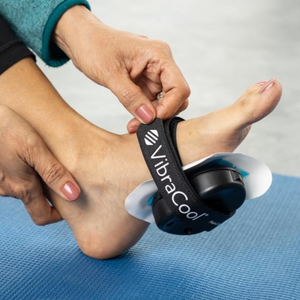
- Attach the ice pack to the unit Place the ice pack over the curved vibration unit. The curve is contoured specifically to fit into the arch of the foot and position the active end as close as possible to the plantar fascia insertion point at the heel.
- Secure it to your foot Feed the strap through the ice pack, then through the unit itself, and wrap it securely around the arch of the foot. The vibration unit should sit directly over the plantar fascia.
- Switch it on and sit for 20 minutes Activate the vibration and sit with your foot elevated or resting. Dr Baxter recommends 20 minutes per session, up to twice a day, and up to three times for very bad cases.
- Use it before moving after rest The best time to use VibraCool is before you get up after a period of sitting, or before those first steps in the morning. This prepares the tissue before it is loaded, which is when plantar fasciitis pain is worst.
When to expect results
Dr Baxter notes a clinical difference within days of consistent use. Cases that have already been through steroid injections and shockwave therapy may need a full month before they notice they no longer have pain.
VibraCool Plantar
A wearable M-Stim device designed specifically for plantar fasciitis and heel pain. Combines patented high-frequency mechanical stimulation with freeze-solid ice therapy. Drug-free, hands-free, and clinically backed.
When to See a Podiatrist or Physiotherapist
VibraCool is designed for home use and is most effective for mild to moderate plantar fasciitis and for managing ongoing symptoms. If your heel pain has not improved after six weeks of consistent home management, it is worth getting a professional assessment.
For advanced or chronic cases, VibraCool can be used alongside physiotherapy, custom orthotics, or shockwave therapy. Dr Baxter notes that combining vibration with other treatments can improve outcomes, which is consistent with the 2024 Sahmyook University trial showing vibration plus shockwave outperformed shockwave alone.
More from Buzzy4Shots
- VibraCool Plantar — shop now
- Shop all VibraCool models
- How VibraCool works
- VibraCool Research & Clinical Trials
- VibraCool for injuries
- Differences between VibraCool models
- NDIS claim information
- TENS vs Mechanical Vibration Therapy: what the research shows
- How long does plantar fasciitis take to recover?
- What is plantar fasciitis and why does my heel hurt?
Plantar fasciitis is not just inflammation. It is a degeneration and overuse problem that needs increased blood flow, fibre separation, and pain relief.
VibraCool Plantar addresses all three at once. Drug-free, wearable, and backed by independent clinical research. Learn more about VibraCool Plantar here.
Frequently Asked Questions
Is plantar fasciitis caused by inflammation?
Modern research shows plantar fasciitis is primarily caused by repeated overuse and micro-tears in the plantar fascia tissue rather than chronic inflammation. This is why anti-inflammatory approaches alone often provide only partial or temporary relief.
How does VibraCool help plantar fasciitis?
VibraCool uses high-frequency mechanical stimulation at 150 to 200 Hz to increase blood flow to the plantar fascia through vasodilation, separate stiffened fibres, and reduce pain. The ice pack simultaneously reduces cytokine formation and pain signals. Learn more on our how VibraCool works page.
How often should I use VibraCool for plantar fasciitis?
Dr Amy Baxter recommends 20 minutes per session, twice a day. For very bad cases, up to three times per day. She also notes that 20 minutes twice daily worked better than 10 minutes three times daily. It is most effective when used before getting up after a period of rest.
How quickly does VibraCool work for plantar fasciitis?
Most people notice a difference within a few days of consistent use. Cases that have already had cortisone injections or shockwave therapy may take up to a month for full relief as the tissue recovers.
Is VibraCool better than ice alone for plantar fasciitis?
Ice alone reduces pain and inflammation temporarily but does not increase blood flow or separate stiffened fibres. VibraCool combines cold therapy with high-frequency vibration to address both at once.
Can VibraCool be used alongside other plantar fasciitis treatments?
Yes. VibraCool works well alongside physiotherapy, stretching programs, orthotics, and shockwave therapy. A 2024 randomised controlled trial found that combining local vibration with shockwave therapy produced better outcomes than shockwave therapy alone.
Is VibraCool safe with a pacemaker?
Yes. VibraCool uses mechanical vibration, not electrical stimulation. It is suitable for people with pacemakers, unlike TENS machines. See the differences between VibraCool models for more detail.
Is VibraCool Plantar available in Australia and New Zealand?
Yes. VibraCool Plantar is FDA 510(k) cleared and TGA accepted in Australia. It ships from New Zealand with flat rate delivery across both countries. Shop VibraCool Plantar here.
Mentioned in this article
More stories

How Long Does Plantar Fasciitis Take to Heal?
